16 December 2021
Anjouan deforested, Anjouan to reforest
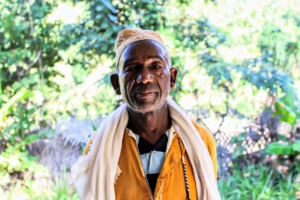
Testimony from Mr Nabouhane Abdallah, aged 77, Head of the Reforestation Committee, on the consequences of deforestation on…
At around 1,000 m high, the temperature drops at night and, at 7 pm, the research team, made up of ecologists from Dahari and students from the University of Comoros, are already wearing jumpers. To be honest, the coolness is a real relief compared to the temperatures we experience in town during the day – the rainy season here on Anjouan is hot and humid!
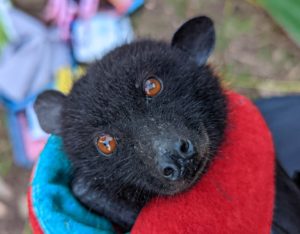
That night, we pitched our tents on a plateau north of Adda village, near an important site for the rest and feeding of Livingstone's fruit bats, one of the rarest and largest bats in the world. These bats are the reason for our presence here: Dahari and the University of Comoros have launched a research project to find out where the bats go, what they eat, and how they use their habitat, with the ultimate goal of finding better ways to protect them from extinction.

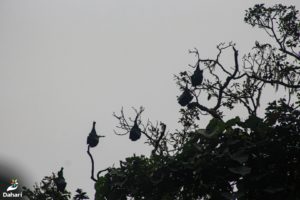
Livingstone's fruit bats depend on large trees in forests and are threatened by deforestation.
Bats are threatened by the destruction of forests, their natural habitat. They depend on large trees in forest areas for roosting during the day. A roost site can comprise several trees and is important for social contact and undisturbed rest. We know where all the main roosts are on the island of Anjouan, and Dahari is working hard with local landowners to protect these trees. However, roost sites are not the only areas to protect: feeding sites are also key areas. But as very little is known about where, when and what Livingstone's fruit bats eat, we therefore launched, with the support of the CEPF and of the Rufford Foundation, the first GPS tracking study of these bats!
Forest disappearance
As well as identifying feeding sites, we plan to better understand how the bats manage the fragmented landscape. On Anjouan, there is very little natural forest left, and the forest fragments are often located on steep slopes, and very far apart. Fortunately for them, large bats can travel long distances. Fields and plantations also still offer some trees for a tired bat, but previous research has actually shown that bats in general do not like to stay in open spaces – we will see how Livingstone’s bats manage here in the Comoros.

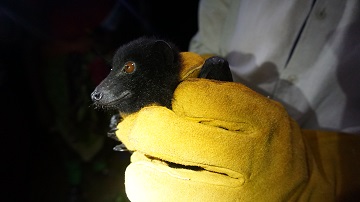
The two bats have been measured and weighed.
In January and February 2019, we fitted GPS collars onto two individuals: a female and a male. The GPS tags record their movements in great detail and also provide us with information about the speed at which the animal is moving when the points are taken. However, there is a slight difficulty: we have to find the bats to download the data from the tags! Thus, during the first two weeks following the fitting of the GPS, the team spent their time searching for the bats around Adda, Outsa, Ouzini and even Moya... Fortunately, we found them after a few days and the first data we have already indicates where they like to spend their days, which has helped a great deal. Now, we simply need to go to their preferred roosts during the day to download the data.
The GPS collars are lightweight and these giant bats can carry them easily. The collars weigh 20g each; considering the average weight of a bat is 630g, they pose no problem to the animals. Furthermore, we have designed them to fall off by themselves after approximately six to eight weeks. This will leave the bats without any trace, and we will then, if all goes well, be able to retrieve the GPS tags and reuse them later.
Identify feeding sites

The collar is very light and is designed to fall off on its own after a few weeks.
These two bats are very active individuals and, from the first week, Dahari was able to include the places they frequented in the participatory monitoring project. The next step is to identify feeding sites (the ecology team will have to go into the field again to identify arboreal species).
Meanwhile, the bats will be flying, and as long as the batteries in the GPS tags last, they will continue to give us more information about their lives. We are excited to discover their next destination!