18 August 2026
Agro-ecological solutions for sustainable farming in the Comoros
Since 2022, we have therefore been working with a network of 19 farmers in Anjouan and Grande Comore to test solutions based on locally available resources...

On May 14, the NGO organized an open day at the CRDE (Regional Center for Economic Development) for the Domoni prefecture, located in Salamani, in the eastern part of the island of Anjouan.
Inzou Ali, an agricultural technician at Dahari and the event organizer, tells us about it.
“The purpose of the day was to raise awareness among the villagers in the area around Domoni. It is important to inform them about Dahari’s activities, so that they understand how we can help them. That is why we organized an open day.”
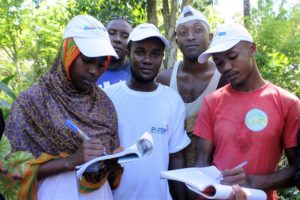
For this demonstration day, organized in collaboration with the director of the CRDE and his technical staff, the center was opened to everyone—local residents, beneficiaries of the NGO, as well as students from the nearby middle school in Domoni and representatives from the Ngandzalé town hall. We are quite pleased with the turnout, which reached nearly 100 participants.
During the morning, we showed visitors our demonstration plots—areas used by Dahari to conduct training sessions and showcase specific techniques or seed varieties.
Emphasis was placed on demonstrating onion cultivation using the mulching technique. This technique involves covering the soil with straw just before sowing seeds or transplanting seedlings.
During the session, we explained the many benefits of mulching to the audience:
I shared two anecdotes with the guests regarding crops grown using the mulching technique.
The first concerns an experiment conducted in Ouzini in 2013. We planted the same onion seeds on two plots, one with mulch and the other without. The mulched plot, with an area of 48 square meters, yielded a harvest of 92 kg (or 1.91 kg/m2The unmulched plot, with an area of 88 square meters, yielded a harvest of 62 kg (or 0.70 kg/m²).2).
The second experiment concerns peanut cultivation at the CRDE in Salamani in 2014. The harvest was measured in buckets because scales were unavailable. We used a 10-liter bucket. With an unmulched area of 20 square meters, the harvest yielded 1/4 of a bucket (0.0125 buckets/m2With a straw-covered area of 80 square meters, the harvest was 3.75 buckets (or 0.0468 buckets/m²).2).
These two anecdotes are examples of successful mulching, with yields multiplied by 3 or 4—not to mention the savings in water and energy that mulching provides.
 The morning concluded on a festive note: at the end of the session, we awarded certificates to participants from the village of Ngandzalé who had attended more than 50% of the training sessions for the 2013 market-gardening season. We took advantage of this open day to explain to the participants the various demonstrations that Dahari has set up in collaboration with the CRDE team. Several techniques were presented, including the use of liquid fertilizer, market-garden nurseries, improved cattle enclosures, recently introduced improved varieties of banana and forage crops, as well as legumes—such as a plot of Stylosanthes.