11 September 2020
Three years with the European Union in numbers
The «Agricultural Development Model Expansion» project, implemented between 2017 and 2019 and funded by…
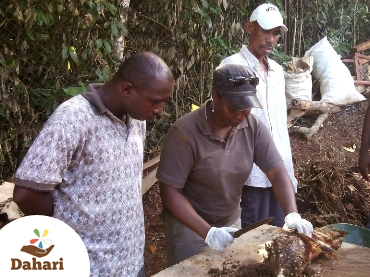
In June 2014, three representatives from our team participated in training funded by the Regional Cooperation Fund (FCR) of the Mayotte Prefecture, focusing on the propagation of banana plants. Our rural development officer, Badroudine Ali, recounts the training and how these learnings will be applied in the Dahari intervention zone.
“Several varieties of banana multiply essentially through vegetative propagation (1), particularly by sucker separation (2). Each sucker can give rise to a banana plant. Plantain and dessert banana varieties are of particular interest and are sold at a high price, especially during Ramadan and holiday periods. For these varieties, the ability to produce suckers is generally low: during the lifespan of the banana plant (10 to 14 months), only 3 to 5 suckers are found. Thus, the possibilities for rapid intensification of cultivation are limited. In addition to this observation, producers often use planting material contaminated by pests such as nematodes and insects like weevils. There is therefore a need to use new techniques to mass-produce good quality suckers in a short time.
It is for this reason that three representatives from our technical team travelled to Mayotte from 4 to 6 June 2014 to attend training organised by the Chamber of Agriculture, Fisheries and Aquaculture of Mayotte as part of the Pilot project for the establishment of a healthy banana plant production unit, on the site of the nursery La Flore de Mayotte, with funding from the FCR.
The objective was to transfer multiplication techniques to private banana nursery growers in Mayotte and Anjouan to meet, in both territories, the strong demand from farmers on both islands for banana plantlets of various varieties in terms of quantity, regularity, and diversity. The aim of the training was also to enable technicians to exchange knowledge on the rapid production of healthy banana plants.

During the training, various multiplication techniques were covered, particularly the PIF method, which is central to the training as it is what will be practiced in Anjouan. Enhanced by this training, our Dahari technical team, strengthened by these experiences, is ready to relaunch its banana plant nurseries in Anjouan in partnership with the sites of other nursery operators from the Bahati Ya Walimizi association of SNAC, who also attended this training.
Upon returning from the training, initially, the Dahari technicians were trained on the technique. Then, at our CRDE site in Domoni, the first nursery bed was filled and the suckers began to emerge. At the agricultural support site in Mpagé, the nursery bed is in the process of being filled. This training highlighted the PIF technique, which allows for the exploitation of most of the plant's buds. A banana plant that only produces 3 to 5 suckers actually has the potential for over a dozen buds.
This technique will particularly contribute to the development of Anjouan, as it helps to combat weevils, it will allow for an increase in banana production, and it can be applied to other varieties.”
1. Vegetative reproduction: asexual reproduction that occurs from a plant organ (stem, bud or leaf)
Cutting: A plant growing from another by asexual reproduction