11 September 2020
Three years with the European Union in numbers
The «Agricultural Development Model Expansion» project, implemented between 2017 and 2019 and funded by…

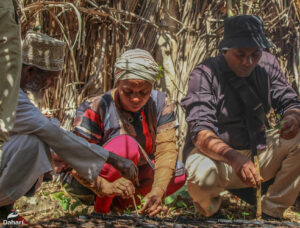
On May 28, the Dahari team organized a field visit to showcase the NGO’s agricultural activities to an official delegation.
Ibrahim Said, executive director of the NGO Dahari, tells us the story.
"On Wednesday, May 28, 2014, in my capacity as Executive Director of the NGO Dahari, I led a tour for Mr. Houmadi Daoud—the Commissioner in charge of Production and the Environment for the autonomous island of Anjouan—accompanied by his Secretary General, Mr. Dhoiharou Toilha. The visit included the villages where the NGO Dahari operates, as well as the CRDE (Regional Center for Agricultural Development) in Salamani."
The tour began in the villages of Adda and Outsa, where I showed the commissioner the model plots belonging to farmers—both men and women—who have received support from the NGO Dahari. On these plots, he was introduced to high-performing imported crop varieties (taro, sweet potato, and potato). He also observed the land management techniques implemented on the plots to ensure sustainable soil stewardship.
At the CRDE in Salamani, the visit reached its highlight: the Commissioner listened to our explanations regarding the innovative agricultural techniques developed at the site—such as direct seeding under plant cover and drip irrigation—as well as improvements made to the "Integrated Crop-Livestock System" (ICLS) approach, featuring a cattle pen model designed to meet the fodder and water requirements for both crop cultivation and livestock rearing on the plots.
At the end of the tour, I sensed a great deal of interest from the Commissioner and his secretary-general regarding the model for providing technical guidance to agricultural producers in the villages. He expressed appreciation for the presence of Dahari’s agronomists alongside the farmers—noting that they remain in the villages 24 hours a day, four days out of every five.
This field visit served to strengthen our collaboration with the Commission in charge of Production and the Environment. Our NGO hopes to assist the Commission in implementing its policy and work plan, to collaborate on regional events, and to secure the Commissioner’s support regarding administrative and policy-related matters. Ideally, in partnership with the Commission, we would like to replicate our intervention model in other areas of the autonomous island of Ndzuwani.